Friday, May 30, 2008

Arenal y Monteverde


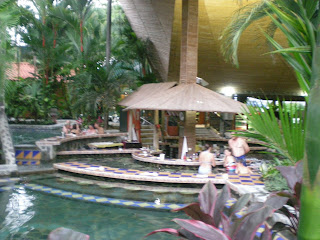
I want to talk about the ecotourism that I experienced this past weekend and how it can be labeled as ecotourism. So we first set off to Arenal on Friday where we experienced the hot springs. The town is lucky to have an active volcano literally miles (or should I say kilometers) away. The volcano has enabled the town to such a high rate of tourism. Using the volcano’s natural heat to heat the hot springs definitely accounts as ecotourism. Baldi, the hot springs resort, attracts tourists but does not in any way (that I know of) damage or harm the volcano. It is all natural.
The next day we set off to Monteverde. In Monteverde we experienced two more ecotourism adventures. One was the zip lining and the second was the rainforest tours we went on. CR used the rainforest to attract us (tourists) to zip line and to attend night and day tours within the rainforest. Although zip lining and the tours were interfering with the habitats of some rainforest animals, it was kept to a minimum. These three (hot springs, zip lining, and the rainforest tours) are perfect examples of ecotourism. Using CR’s natural resources and interfering with the ecosystem as little as possible to attract tourists.

The difference between Oritos, Bananas, and Platanos

Bananas and plantains, as you know, are very prevalent in Costa Rica. I see oritos, bananas, or plantains at least once a day here. Oritos (cooking bananas) are the smallest which average a little less than 15cm. Bananas (aka dessert bananas)are about 20cm. Plantains (unripe plantains) average less than 25cm. The only difference between these items is the amount of starch content. Those with lots of starch are the cooking bananas and unripe plantains and those with very low starch content which are the tasty dessert bananas. Starch is converted to sugar as the fruit ripens. Oritos could be cooked in any way but does not necessarily have to, but plantains must be boiled, steamed, roasted, or deep fried to make it soft and palatable. Plantains are often green or red skinned, and originated from the Spanish word ‘platano.’
The word "banana" originated in coastal West Africa, and was adopted in the New World for the sweet forms with yellow skin. The banana “tree” (which is not really a tree but a tree-like perennial herb) grows in the humid tropics like a grass. It becomes a tree within a year. Banana is a monoecious plant. Monoecious means having both male and female organs. It has male flowers at the tip and female flowers behind.
So now that I know a little bit more about bananas, I now understand why they are so popular here. Obviously the climate has a lot to do with them growing here so easily and that they can be prepared in many different ways. The typical dish in CR consists of white rice, black beans, fried plantains, and some type of meat. I’ve also noticed that most of the bananas here are brown. My guess is that because many countries import their bananas from CR, CR sends these countries the ripe bananas so that they don’t go bad before they reach there. I guess we’ll have to wait and see until we visit the banana plantations.

Thursday, May 29, 2008

Manuel Antonio Trip

Our trip to the beach! 27 students with no chaperones. Our professors decided to cancel class so they could go to lets just say a country that is less than acceptable according to the US government. Yeah for us! The beach was fun, besides the huge waves due to the tropical storm we are experiencing. It rained the whole time and there was no sun at all. Oh, and the natives who tried charging us for ridiculous stuff, like using the free chairs and umbrellas on the beach. Live and learn!
Can you say ¨4 hours with no leg roomBesides Beth there, she got lucky.

We saw 5 HUGE crocodiles! Count them.

Up close and personal!

At a restaurant getting some grub!

Bonding!

Monday, May 26, 2008

Mas Fotos

Typical tourist gift shop in Monteverde (not very authentic is it?)
Scenery from the boat ride (from Arenal to Monteverde= BEAUTIFUL!)
Dried lava from the volcano

Amazing waterfall with extremely cold water!

Hydration plant! All of Costa Rica's electricity and telephone power come from its natural resources (water)

Baldi, a hot springs resort near the valcano. The water is heated from the natural heat of the volcano. There were different temperatures of water (I got in the hottest one, 150 F, oh yeah!)
The volcano itself. It's active! So beautiful it looks fake.

Glenn sleeping. He looks so peaceful (tear).


Friday, May 23, 2008

Fotos


Personal Reflection


Coming to Costa Rica I knew a little bit about what to expect. It is very similar to Mexico, the way the meals are prepared and even some of the meals. They eat with tortillas! What I was most surprised about was the taxis. I’ve never heard of anyone pirating a taxi. I’ve made the mistake of speaking English in the taxis many times, so they keep overcharging us. What the heck! That is so frustrating when you can’t trust someone, which is common here in Costa Rica. They tell us so many stories here about tourists who have been robbed or held at gun point. I feel like there’s ticos out there with knives and guns just waiting for us. I feel so unsafe here. Juliana even told me a story about how her cousin (a tico) got jumped and robbed twice in one night, by the same people. I want to say that this would never happen in the EEUU, but I know it does.
Did I mention it rains here like every single day? It’s a wonder how these people aren’t pruney all the time! I actually bought an umbrella the other day, but them Juliana accidently lost it that same day.
I love the people here, they are so exotic looking!
So about our host family. I’m not going to lie they are a little odd, but never the less they are welcoming. Carlos (the husband) has his own snow cone business and is a tour guide for cruise ships. He even works with (some big company that I forgot) and evaluates other tour guides performance. Pretty cool! Anyways, so everything’s going great, and as you can see I’m still alive. Hasta luego, y Pura Vida!

Thursday, May 22, 2008

Ecotourism


So Costa Rica pretty much depends a lot on its tourism, but so do many other countries. The interesting thing is how CR uses its agriculture and vegetation to attract its customers (tourists). This form of tourism that appeals to ecologically and socially conscious individuals is known as ecotourism (ecological tourism). Costa Rica is ideally situated to take advantage of the growing demand for ecotourism. While other developing nations are focusing on industrialization and urbanization, Costa Rica has turned to ecotourism to further develop economically. The goal of ecotourism is to preserve a nation's natural resources while profiting from them.
Although the country seems small, Costa Rica has an incredible array of biodiversity, including: beaches, rainforests, national parks, etc. Costa Rica’s ecotourism industry earns more than $1 billion every year. Earning more than the coffee and banana industry combined
.